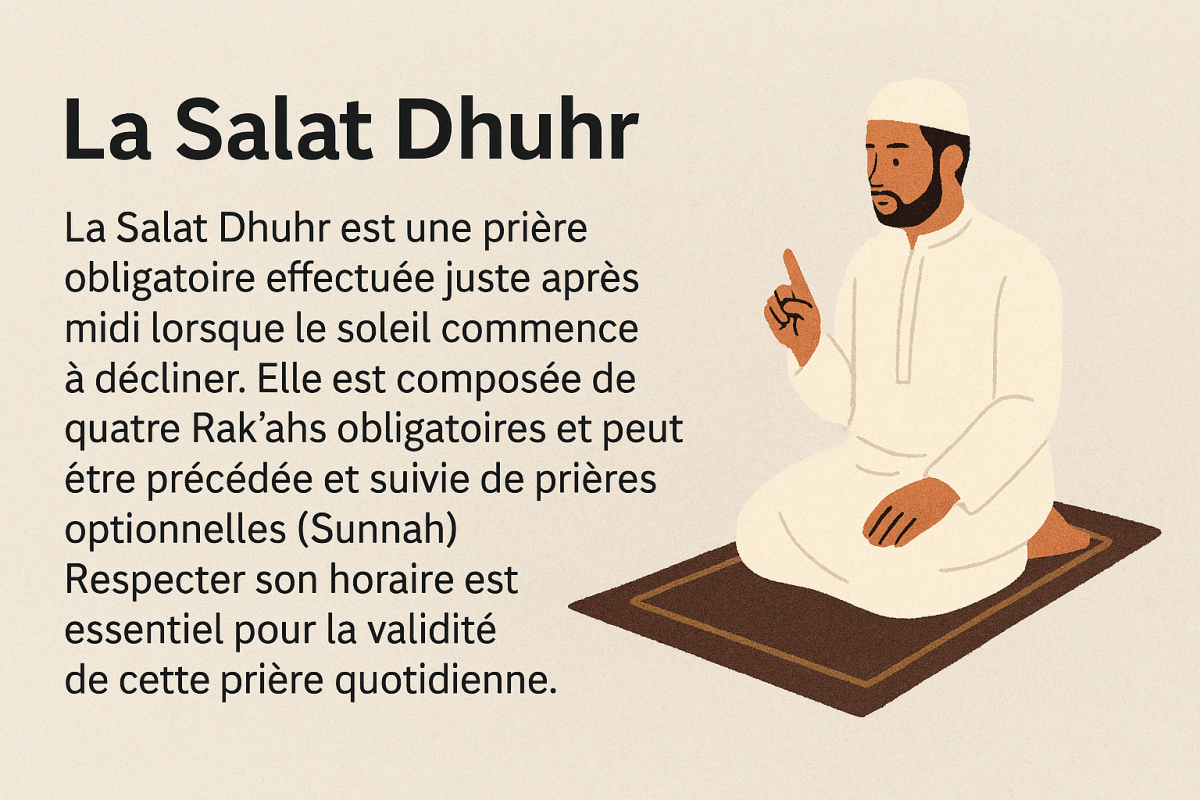
Salat Dohr (صلاة الظهر) is the noon prayer, the second of the five obligatory daily prayers (الصلوات الخمس) in Islam. Composed of four rak'ahs (ركعات) recited silently, it begins at the decline of the sun (زوال الشمس) and ends when the shadow of an object equals its height. The Prophet ﷺ associated with it supererogatory prayers (رواتب) — four rak'ahs before and two after — which scholars consider among the most meritorious. The salat ad-dhuhr occupies a central place in the daily practice of the Muslim: it marks the middle of the day, reminds one of dependence on Allah, and offers an essential spiritual pause.

Key Points — In Brief
- Definition: Salat ad-Dhuhr (صلاة الظهر) = midday prayer, 4 obligatory rak'ahs recited silently.
- Beginning: at the decline of the sun after zenith (زوال). End: when the shadow of an object equals its own length (according to the majority of scholars).
- Sunan Rawâtib: 4 rak'ahs before + 2 rak'ahs after (hadith of Umm Habîba, Muslim no. 728).
- Recitation: silent (سرية) — unlike Fajr, Maghrib and 'Ishâ'.
- Rank: second prayer of the day, between Fajr and 'Asr — considered the "median prayer" (الصلاة الوسطى) by some exegetes.
Quranic and Prophetic Foundations
Quranic Proofs
The obligation of prayer — and its performance at the prescribed times — is established by numerous verses of the Quran:
« Perform the prayer (الصلاة), for prayer remains, for the believers, an obligation at determined times. » (Quran 4:103)
This verse uses the term kitâban mawqûtan (كتابًا موقوتًا), literally « a writing fixed in time », emphasizing the inescapable nature of respecting the schedules. Ibn Kathîr comments in his Tafsîr al-Qur'ân al-'Adhîm that this verse implies that each prayer possesses a defined time which it is forbidden to exceed without a legitimate excuse.
The Quran also mentions the noon prayer in a specific manner:
« Be assiduous in prayers and in the middle prayer (الصلاة الوسطى), and stand before Allah with humility. » (Quran 2:238)
Among the exegetes, Ibn 'Abbâs and Zayd ibn Thâbit identified the middle prayer as being salat ad-dhuhr, because it takes place in the middle of the day. Other scholars, such as 'Alî ibn Abî Tâlib, identified it with the 'Asr prayer — which testifies to the richness of the exegetical debate surrounding this verse.
Prophetic Proofs
The Prophet ﷺ specified the times of each prayer in a hadith reported by Muslim (no. 612) from 'Abd Allâh ibn 'Amr:
« The time of Dhuhr enters when the sun declines and the shadow of a man equals his own height, as long as 'Asr has not entered. »
Similarly, in the hadith of the imamate of Jibrîl (reported by at-Tirmidhî, no. 149 and Abû Dâwûd, no. 393), the angel Jibrîl led the Prophet ﷺ in prayer for two consecutive days to teach him the first and last time of each prayer. For Dhuhr, Jibrîl prayed on the first day just after the zenith, and on the second day when the shadow of an object reached its own length.

The Secrets of Prayer — Questions and Answers
According to Cheikh al-Houwaymidi — Al-Imen Editions
An Al-Imen work that answers essential questions about prayer: conditions, pillars, common mistakes and keys to concentration.
Linguistic Analysis of the term Dhuhr
The word Dhuhr (ظُهْر) comes from the Arabic root ظ-ه-ر (dhâ'-hâ'-râ') which carries the meanings of "appearance," "back," "evidence," and "midday."
- ظُهْر (dhuhr) : the middle of the day, the moment when the sun reaches its highest point
- ظَهَرَ (dhahara) : to appear, to become evident — because the heat of the sun "appears" fully at this moment
- ظَهِيرَة (dhahîra) : high noon, the hour of intense heat
Scholars explain that this prayer is named Dhuhr because it is performed at the moment when the sun is at its apparent zenith, then begins its descent. In classical Arabic, it is also called salat adh-dhahîra (صلاة الظهيرة), both forms being attested in collections of hadith.
Precise Prayer Times and Time Determination
The Beginning of Dhuhr Prayer Time
The time of salat ad-dhuhr begins immediately after the decline of the sun (زوال الشمس), that is, as soon as it leaves the meridian and the shadow of an object begins to grow after reaching its minimal point at solar noon. This principle has unanimous agreement (إجماع) among the four juridical schools (Hanafi, Maliki, Shafi'i, and Hanbali).
The End of Dhuhr Prayer Time
This is where a juridical disagreement exists between the schools:
| Position | Schools | End Criterion |
|---|---|---|
| Majority | Maliki, Shafi'i, Hanbali | When the shadow of an object equals its own length (in addition to the shadow at zenith) |
| Hanafi Opinion | Hanafi (Abû Hanîfa) | When the shadow of an object reaches double its length |
The majority position is based on the hadith of the imamate of Jibrîl (at-Tirmidhî no. 149). The Hanafi position relies on another hadith transmitted by Ibn 'Abbâs. In practice, it is recommended to pray at the beginning of its time (أول الوقت), in accordance with the hadith reported by al-Bukhârî (no. 527) and Muslim (no. 85) where the Prophet ﷺ was asked about the most meritorious deed and replied: "Prayer performed at its appointed time."
Discouraged Times
It is forbidden (حرام) to pray at the exact moment of zenith (وقت الاستواء), that is, when the sun is at the peak of its course, until it declines. The Prophet ﷺ said: "Three times during which the Messenger of Allah forbade us to pray and to bury our dead: when the sun rises until it ascends, when it is at zenith until it declines, and when it turns red until its setting." (Muslim, no. 831)

The Book of Prayer — Encyclopedia of Islamic Law (Vol. 2)
Dr. Hassan Amdouni — Al-Imen Editions
Al-Imen reference work covering comprehensively all juridical aspects of prayer: conditions, times, pillars and exemptions according to the four schools.
Conditions of Validity and Pillars of Prayer
The nine conditions (شروط الصلاة)
The imam Muhammad ibn 'Abd al-Wahhâb summarized in his famous epistle Shurût as-Salât the nine conditions that the person praying must fulfill for their prayer to be valid:
- Islam — prayer is not accepted from the disbeliever
- Reason (العقل) — the sleeping or unconscious person is exempt from it
- Age of discernment (التمييز) — generally set at seven years for learning
- Removal of ritual impurity — by ablutions (الوضوء) or ritual bathing (الغسل)
- Purification from impurities — on the body, clothing and place of prayer
- Covering of the 'awra (ستر العورة) — the area of the body to be covered
- Entry into the prescribed time — each prayer has a defined time slot
- Facing the Qibla (استقبال القبلة) — direction of the Ka'ba in Mecca
- Intention (النية) — formulated in the heart before the opening takbîr
The fourteen pillars (أركان الصلاة)
Among the essential pillars of each prayer, salat ad-dhuhr includes in particular: standing (القيام), the opening takbîr (تكبيرة الإحرام), recitation of the Fâtiha in each rak'ah, bowing (الركوع), rising, prostration (السجود), sitting between the two prostrations, the final tashahhud and the taslîm (final greetings).

The Conditions of Prayer, Its Pillars and Its Obligations
An essential classical epistle that summarizes the fundamentals of prayer in a methodical way.
View the book
The Book of Purification — Vol. 1
Hassan Amdouni (Al-Imen). Complementary volume of the Encyclopedia of Islamic Law dealing in depth with ablutions and ritual purity.
View the bookPerforming the Dhuhr Prayer Step by Step
Preparation
Before beginning the prayer, make sure you have performed ablution (الوضوء) correctly. Face the Qibla (القبلة) and form the intention in your heart to pray four rak'ahs of the Dhuhr prayer.
First Rak'ah
- Takbîrat al-Ihrâm (تكبيرة الإحرام): standing, raise your hands to shoulder or ear level and say "Allâhu Akbar" (الله أكبر).
- Opening Supplication (دعاء الاستفتاح): recite an opening invocation (recommended, not obligatory).
- Recitation of Al-Fâtiha (سورة الفاتحة): recite it silently — this is a pillar of every rak'ah. Conclude with "Âmîn" (آمين).
- Additional Chapter or Verses: recite silently a chapter or some verses after Al-Fâtiha (recommended in the first two rak'ahs).
- Rukû' (الركوع): say "Allâhu Akbar", bow with your hands on your knees, back straight, and repeat three times "Subhâna Rabbiya-l-'Adhîm" (سبحان ربي العظيم).
- Rising: straighten up saying "Sami'a-Llâhu liman hamidah" (سمع الله لمن حمده), then add "Rabbanâ wa laka-l-hamd" (ربنا ولك الحمد).
- First Prostration (السجود): place your forehead, nose, two hands, knees and feet on the ground, and say three times "Subhâna Rabbiya-l-A'lâ" (سبحان ربي الأعلى).
- Sitting Between the Two Prostrations (الجلسة بين السجدتين): sit and say "Rabbi-ghfir lî" (رب اغفر لي).
- Second Prostration: identical to the first.
Second Rak'ah
Rise saying "Allâhu Akbar" and repeat the same steps as the first rak'ah (Al-Fâtiha + chapter + rukû' + two prostrations). At the end of the second rak'ah, remain sitting for the first tashahhud (التشهد الأول):
"At-tahiyyâtu li-Llâhi wa-s-salawâtu wa-t-tayyibât, as-salâmu 'alayka ayyuhâ-n-Nabiyyu wa rahmat Ullâhi wa barakâtuh, as-salâmu 'alaynâ wa 'alâ 'ibâdi-Llâhi-s-sâlihîn. Ash-hadu an lâ ilâha illa-Llâh, wa ash-hadu anna Muhammadan 'abduhu wa rasûluh."
Point with your right index finger during the shahâda, then rise saying "Allâhu Akbar" for the third rak'ah.
Third and Fourth Rak'ahs
In the last two rak'ahs, recite only Al-Fâtiha (without an additional chapter, in accordance with the Sunna). After the fourth prostration of the final rak'ah, sit for the complete tashahhud: the preceding text followed by the salawât al-ibrâhîmiyya (الصلاة الإبراهيمية):
"Allâhumma salli 'alâ Muhammad wa 'alâ âli Muhammad, kamâ sallayta 'alâ Ibrâhîm wa 'alâ âli Ibrâhîm, innaka Hamîdun Majîd…"
The Taslîm (Final Salutations)
Complete the prayer by turning your head to the right saying "As-salâmu 'alaykum wa rahmat Ullâh" (السلام عليكم ورحمة الله), then to the left repeating the same formula. This concludes your salat ad-dhuhr.

The Prayer of the Prophet
Practical guide describing the prayer of the Prophet ﷺ from beginning to end, based on authentic hadiths.
View the book
Understanding and Correcting the Prayer
Educational work that identifies frequent errors in prayer and explains how to correct them.
View the book
Supererogatory Prayers Associated (السنن الرواتب)
The salat ad-dhuhr is the prayer that benefits from the greatest number of supererogatory rak'ahs (رواتب). The Prophet ﷺ said:
« Whoever prays twelve rak'ahs during the day and night (apart from the obligatory prayers), Allah will build for him a house in Paradise. » (Muslim, no. 728)
| Time | Number | Manner | Status |
|---|---|---|---|
| Before Dhuhr | 4 rak'ahs | Two salutations (2+2) | Sunna mu'akkada (confirmed) |
| After Dhuhr | 2 rak'ahs | One salutation only | Sunna mu'akkada (confirmed) |
| Additional Option | 2 rak'ahs before | In addition to the 4 preceding | Recommended (hadith at-Tirmidhî no. 428) |
The hadith reported by Umm Habîba (Muslim, no. 728) mentions that among the twelve rak'ahs of the day, four precede Dhuhr and two follow it. Ibn al-Qayyim notes in Zâd al-Ma'âd that the Prophet ﷺ never neglected these supererogatory prayers, even while traveling — when he reduced the obligatory prayers to two rak'ahs but could maintain the nawâfil of Dhuhr.
Mindfulness (الخشوع) in Prayer
The khushû' (الخشوع) is the soul of prayer. Allah says in the Quran:
« Blessed indeed are the believers, those who are humble in their prayer. » (Quran 23:1-2)
Ibn Rajab al-Hanbalî explains in his treatise on humility in prayer that khushû' involves the presence of the heart (حضور القلب), the tranquility of the limbs (سكون الجوارح) and the awareness of the meaning of the recited words.
Practical Means to Strengthen Khushû'
The scholars — in particular Ibn al-Qayyim in as-Salât wa hukm târikihâ and al-Ghazâlî in Ihyâ' 'Ulûm ad-Dîn — recommend several means:
- Prepare your heart before the takbîr: invoke Allah, empty yourself of worldly concerns
- Meditate on the meaning of the verses recited — understand the Fâtiha deeply
- Take your time in each position: the tuma'nîna (الطمأنينة) is an obligatory pillar
- Fix your gaze on the place of prostration to avoid distractions
- Picture the greatness of Allah and that you stand before Him
- Pray as if it were your last prayer, according to the prophetic advice

33 Advices to Attain Khushû'
Practical guide of 33 concrete means to improve your mindfulness in prayer, based on the Quran and the Sunnah.
View the book
Humility in Prayer
Classical treatise by the great Hanbali scholar on the spiritual foundations of mindfulness.
View the book
Concentration in Prayer
Concise work on the keys to concentration and the causes of distraction to avoid during salah.
View the book
The Lights of Prayer
Deep spiritual reflection on the inner dimension of prayer and its secrets.
View the bookCommon Errors and Corrections
Errors Related to Prayer Times
- Praying before the actual decline of the sun — prayer performed before the entry of its time is invalid by consensus. Use a reliable prayer calendar or a recognized application.
- Systematically delaying Dhuhr without legitimate reason — the Prophet ﷺ recommended praying at the beginning of the prescribed time.
Errors in Execution
- Rushing through movements (عدم الطمأنينة) — the Prophet ﷺ observed a man praying hastily and told him: "Go back and pray, for you have not prayed" (al-Bukhârî, no. 757). Tuma'nîna (tranquility in each position) is an obligatory pillar.
- Forgetting the first tashahhud — if omitted unintentionally, perform two prostrations of compensation (سجود السهو) before or after the taslîm.
- Reciting aloud — unlike Fajr, Maghrib and 'Ishâ', Salat Dhuhr is a silent prayer (صلاة سرية). Only the imam may recite softly enough for nearby rows to perceive the Fâtiha.
- Not reciting the Fâtiha in each rak'ah — its recitation is a pillar according to the majority of scholars, in accordance with the hadith: "There is no prayer for one who does not recite the Fâtiha." (al-Bukhârî, no. 756)

The Abandonment of Prayer
Important work on the consequences of abandoning prayer and the motivations for maintaining regularity.
View the bookPoints of Jurisprudence (Fiqh)
The Combining of Prayers (Jam')
In certain circumstances, it is permissible to combine (الجمع) the Dhuhr prayer with the 'Asr prayer:
- While traveling (السفر): combining is permitted by consensus, whether it is anticipated (جمع تقديم, praying both at the time of Dhuhr) or delayed (جمع تأخير, praying both at the time of 'Asr).
- In case of intense rain or illness: permitted according to the Shāfi'ī and Hanbalī schools.
- Shortening of rak'ahs while traveling (القصر): the four rak'ahs are reduced to two for the traveler, in accordance with the Qur'an (4:101).
Friday Prayer (Jumu'a) and Dhuhr
On Friday, the salat al-jumu'a (صلاة الجمعة) — composed of two rak'ahs — replaces the Dhuhr prayer for resident men who have no valid excuse. The Prophet ﷺ said: "The Friday prayer is an obligation for every Muslim in congregation." (Abū Dāwūd, no. 1067). Women who do not attend Jumu'a pray Dhuhr normally (4 rak'ahs).

The Book of Prayer (Fiqh as-Salat)
Complete French-speaking reference on the jurisprudence of prayer: ablutions, conditions, pillars, practical cases and dispensations.
View the book
The Rules of the Call to Prayer
Al-Imen treatise on the adhān and iqāma: their legal status, formulations and merits.
View the book
Teaching Dhuhr Prayer to Children
The Prophet ﷺ said: "Order your children to pray at the age of seven years, and discipline them for it at the age of ten years." (Abû Dâwûd, no. 495). For Dhuhr in particular, several pedagogical approaches prove effective:
- Praying together: have the child stand next to the parent to observe and imitate the movements
- Starting with Al-Fâtiha: memorize it first, as it is the pillar of each rak'ah
- Explaining the silence: help the child understand why Dhuhr is recited silently (unlike Fajr)
- Using visual aids: illustrated books, puzzles and adapted prayer mats
- Gradual progression: start with two rak'ahs, then gradually increase toward four

I Learn Purification (Boys)
Al-Imen illustrated booklet for teaching ablutions to children, an essential step prior to prayer.
View the book
The Invocations After Prayer
Collection of adhkâr to recite after salat, with Arabic text, translation and transliteration.
View the book
The Fortress of the Muslim
Al-Imen edition of the famous Hisn al-Muslim, including invocations after prayer and daily adhkâr.
View the book
Sahîh al-Adhkâr — The Authentic of Reminders
Trilingual collection (Arabic-French-Transliteration) of authentic invocations, including those after each prayer.
View the bookFrequently Asked Questions
At what exact time does Salat Dhuhr begin?
Salat Dhuhr begins immediately after the decline of the sun (زوال الشمس), that is, when it leaves its highest point and the shadow begins to lengthen. This moment varies according to the region and season — use a reliable prayer calendar or dedicated application to know the exact time in your city.
How many rak'ahs does Salat Dhuhr comprise in total (obligatory + Sunnah)?
The obligatory prayer comprises 4 rak'ahs. The sunan rawâtib add 4 rak'ahs before and 2 after, for a total of 10 rak'ahs. Some scholars also report 2 additional rak'ahs before, bringing the potential total to 12.
Why is Salat Dhuhr recited silently?
The prayers of Dhuhr and 'Asr are recited silently (سرية) because they are performed in broad daylight, a period of activity. Scholars explain that loud recitation is reserved for the night prayers (Maghrib, 'Ishâ') and Fajr, times of calm conducive to listening. This distinction is established by the consistent practice of the Prophet ﷺ reported in the hadith compilations.
Can one make up Dhuhr if the time has passed?
Yes. Whoever misses the Dhuhr prayer for a valid reason (sleep, forgetfulness) must make it up (القضاء) as soon as he remembers, in accordance with the hadith: "Whoever forgets a prayer or falls asleep, his expiation is to pray it when he remembers" (al-Bukhârî, no. 597). Deliberately delaying the prayer outside its time without excuse is a major sin.
What is done on Friday instead of Dhuhr?
On Friday, the Jumu'a prayer (2 rak'ahs with sermon) replaces Dhuhr for men residents with access to a mosque. Women and those exempted from Jumu'a pray normally the 4 rak'ahs of Dhuhr.
What should one do in case of doubt about the number of rak'ahs?
The Prophet ﷺ taught: "If any of you is in doubt about his prayer and does not know whether he has prayed three or four rak'ahs, let him base it on what he is certain of (the lowest number) and perform two prostrations of repair" (Muslim, no. 571). One therefore acts on certainty and completes the missing rak'ahs.
Can the traveler shorten Dhuhr?
Yes. The traveler shortens (القصر) the prayer from 4 to 2 rak'ahs, in accordance with the Qur'an (4:101) and consistent prophetic practice. He may also combine Dhuhr with 'Asr (bringing forward or delaying one of the two).
Additional Resources and Collections
Thematic Hubs (topical authority)
- Learning Prayer — practical guides, illustrated books, methods for adults and children.
- Invocations & adhkâr — collections of invocations after salat and daily.
- Jurisprudence (Fiqh) — works on Islamic law regarding prayer, purification and acts of worship.
- Prayer Mat — luxury velvet mats, with compass, and children's models.
- Faith & Spirituality — contemplation, spiritual development, tawakkul.
- Al-Imen Editions — our own publications on prayer, purification and creed.
Works on Prayer
- The Secrets of Prayer (Al-Imen)
- Encyclopedia — The Book of Prayer (Al-Imen)
- The Prayer of the Prophet (Iqra)
- Understanding and Correcting the Salât
- Fiqh as-Salat (Tawhid)
Khushû' and Contemplation
- 33 Advices for Khushû' (IIPH)
- Humility in Prayer — Ibn Rajab
- Concentration in Prayer
- The Lights of Prayer — Al-Ansârî
Invocations and Purification
- The Fortress of the Muslim (Al-Imen)
- The Invocations After Prayer
- Sahîh al-Adhkâr — The Authentic of Remembrances
- The Book of Purification (Al-Imen)
References
- Quran : 4:103 (prayer at appointed times) ; 2:238 (the middle prayer) ; 23:1-2 (devotion) ; 4:101 (shortening while travelling).
- Al-Bukhârî : n° 527 (prayer at the time), n° 597 (making up missed prayers), n° 756 (Al-Fâtiha obligatory), n° 757 (tuma'nîna obligatory).
- Muslim : n° 85 (best deed), n° 571 (doubt in prayer), n° 612 (times for Dhuhr), n° 728 (sunan rawâtib), n° 831 (forbidden times).
- At-Tirmidhî : n° 149 (leadership of Jibrîl), n° 428 (additional rak'ahs before Dhuhr).
- Abû Dâwûd : n° 393 (leadership of Jibrîl), n° 495 (commanding children to pray), n° 1067 (obligation of Jumu'a), n° 1270 (four rak'ahs before Dhuhr).
- Scholars cited : Ibn Kathîr (Tafsîr al-Qur'ân al-'Adhîm), Ibn al-Qayyim (Zâd al-Ma'âd, as-Salât wa hukm târikihâ), al-Ghazâlî (Ihyâ' 'Ulûm ad-Dîn), Ibn Rajab al-Hanbalî (treatise on khushû'), Muhammad ibn 'Abd al-Wahhâb (Shurût as-Salât).
📚 Also read
−5 % off the entire bookstore with code BLOG5
Valid on the entire website, no minimum purchase required — our thanks to blog readers.
Discover the selection