Nourania Method at School: Implementation, Program and Teacher Selection
In Brief
This article explains how the Nourania Method is used in schools, mosques and Quranic teaching institutes around the world. You will discover the pedagogical adaptations for children's and adults' classes, certifying trainings for teachers, and structural programs over one or two school years.
We share best practices from institutions that have successfully integrated the Nourania Method into their curriculum, with advice on organizing sessions, evaluating students and managing heterogeneous levels. Additional teaching resources for teachers complement this guide for implementation in an educational setting.
Implementing the Nourania Method in a school or institutional context requires a structured and thoughtful approach. Whether you are an Islamic school director, Muslim association coordinator, or educational manager, this comprehensive guide provides you with the tools to establish an effective and sustainable Nourania Method program.
Discover how to organize a progressive curriculum, evaluate learners, choose qualified teachers, and create an optimal learning environment for القاعدة النورانية.

Learning objectives by age group
Group 4 - 5 years old (Nursery)
Objectives:
- Visual recognition of Arabic letters (without emphasis on pronunciation)
- Playful introduction to written Arabic
- Development of concentration (5 - 10 minutes max)
- Simple letter - sound association
Recommended materials: Picture cards, colorful games, Arabic songs, no dense books.
Session duration: 15 - 20 minutes, 3 days per week.
Group 5 - 6 years old (Kindergarten)
Objectives:
- Mastery of isolated letters with pronunciation
- First simple syllables
- Basic letter writing
- Development of study discipline
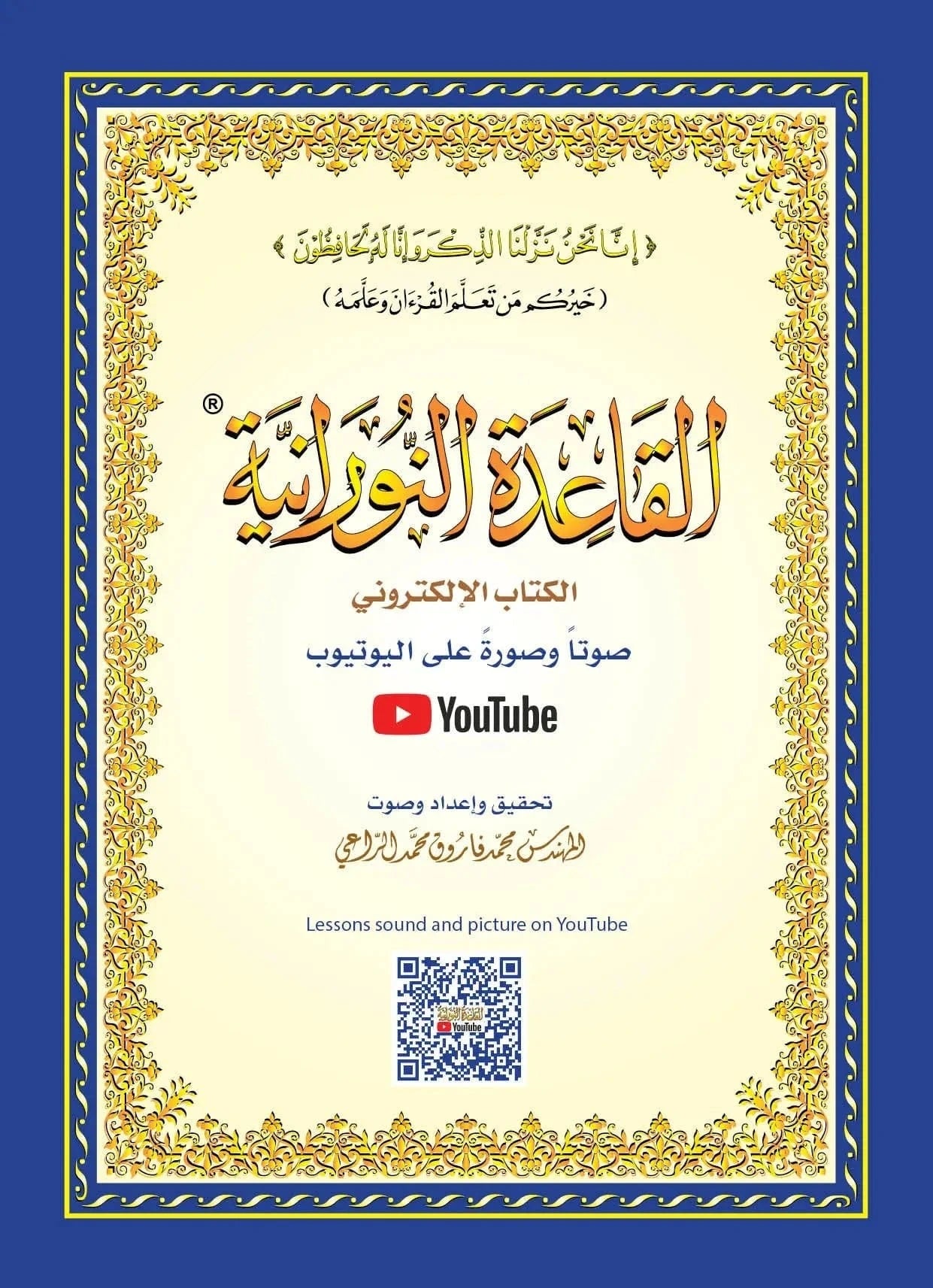
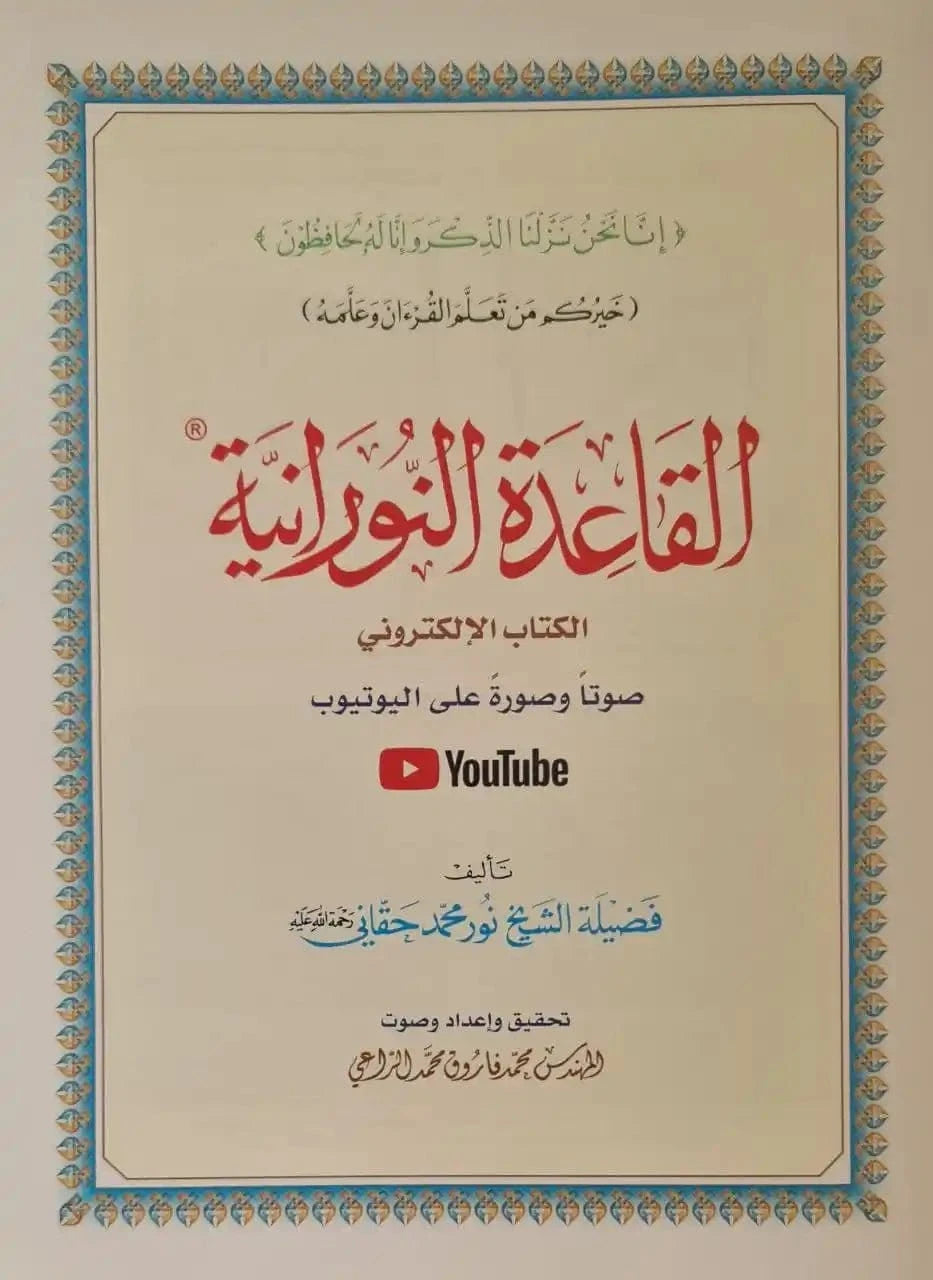
Recommended materials: Nourania Level 1 books, tracing sheets, audio CDs.
Session duration: 20 - 30 minutes, 4 days per week.
Expected progress: Complete mastery of level 1 in 3 - 4 months.
Group 6 - 8 years old (Preparatory - Grade 1)
Objectives:
- Fluent reading of simple Arabic text
- Basic understanding of everyday vocabulary
- Introduction to Quranic verses
- Writing of simple letters and words
Recommended materials: Nourania Levels 2 - 3, adapted Quranic verses, writing exercises.
Session duration: 30 - 40 minutes, 5 days per week.
Expected progress: Progress of 1 level every 6 - 8 weeks.
Group 8 - 10 years old (Grade 2 - 4)
Objectives:
- Fluent reading of the complete Quran
- Introduction to applied tajweed
- Initial memorization of surahs
- Deeper understanding of Arabic vocabulary
Recommended materials: Complete Nourania + applied versions (juzz Amma, Yassin), tajweed materials.
Session duration: 40 - 50 minutes, 5 days per week.
Program Organization: Sequences and Evaluations
Structure of a Pedagogical Sequence (8 weeks)
Weeks 1 - 2: Introduction and Diagnosis
- Assessment of each child's initial level
- Playful introduction to content
- Formation of homogeneous groups (similar levels)
- Clear explanations of objectives
Weeks 3 - 6: Progressive Learning
- Presentation of new content (50% of the time)
- Practice and exercises (30% of the time)
- Review of previous content (20% of the time)
- Regular individual feedback
Weeks 7 - 8: Consolidation and Evaluation
- Formative assessments throughout
- Final progress test
- Detailed feedback to parents
- Planning for the next level
Evaluation System and Monitoring
Daily informal assessments:
- Observation during exercises
- Oral questions to verify understanding
- Immediate and corrective feedback
Weekly assessments:
- Reading test (read 5 - 10 words)
- Pronunciation test (articulate problematic letters)
- Writing exercise (trace 3 - 5 letters)
Monthly assessments:
- Complete progress evaluation
- Detailed report to parents
- Adjustments to the pedagogical plan if necessary
Simple grading scale:
- A+: Excellent mastery (95 - 100%)
- A: Solid mastery (85 - 94%)
- B: Adequate mastery (75 - 84%)
- C: Learning in progress (60 - 74%)
- D: Difficulty - additional support needed (below 60%)

Posters of Qaida Nourania Lesson Board
120.00 EUR
View the productInstructor Manuals and Useful Resources
Guide du professeur (Teacher's Manual)
Essential for any instructor. The guide contains:
- Detailed lesson plans
- Answers to exercises
- Pedagogical advice and classroom management
- Strategies for correcting common errors
- Recommended progressions
- Printable assessment sheets
Worksheets and Supplementary Exercises
Reproduce or purchase additional worksheets:
- Letter tracing sheets
- Progressive reading exercises
- Pronunciation tests
- Revision sheets
- Coloring pages with Arabic letters (for young learners)
Wall Displays and Visuals
Educational posters help:
- Complete Arabic alphabet displayed in class
- Progress chart (where each child stands)
- Isolated letters and connected forms
- Key pronunciation rules
- Inspiring Quranic verses
Audio and Multimedia Resources
- CDs for children without home access
- Tutorial videos for teacher training
- Interactive digital games (limited time)
- Downloadable resources (PDF, worksheets)
Choosing a Teacher: Essential Criteria and Questions
Minimum Qualifications
Required:
- Complete mastery of Arabic reading (minimum 2 years of experience)
- Certification or formal training in Nourania Method (if possible)
- Ability to pronounce Arabic sounds correctly
- Experience with children or adults (minimum 1 year)
Beneficial:
- Teaching certifications (BAFA, pedagogical training)
- Knowledge of tajwid
- Multilingual experience
- Quality reference attestation
Questions to Ask the Candidate
Question 1: "How long have you been using the Nourania Method?"
Look for a minimum of 2-3 years of experience. Less than 1 year = insufficient for this responsibility.
Question 2: "Can you show me your technique for pronouncing difficult sounds (ha, kha, ayn, ghain)?"
A good candidate will pronounce clearly and explain the tongue position. Imprecise pronunciation is a red flag.
Question 3: "How do you handle a child who struggles to pronounce a specific sound?"
Look for a patient and structured answer: "I slow down, show the tongue position, practice in isolation, then reintegrate into the word." No answer = concerning.
Question 4: "Do you have references from schools or institutions where you have taught?"
Verify the references. Talk to previous parents or directors.
Question 5: "How do you measure student progress?"
A good teacher has a clear evaluation system. No system = disorganized pedagogy.
Decision Criteria
Excellent: Certified training + 3+ years of experience + solid references + obvious passion.
Good: 2-3 years of experience + some references + clear pedagogical abilities.
Acceptable: 1-2 years of experience + good pronunciation + active learning in pedagogy.
To Avoid: No experience + poor pronunciation + no pedagogical structure.

Nourania Method Level 1 - Preschool
10.00 EUR
View the product
Finding Associations and Partnerships
Local Islamic Associations
Look for organizations with:
- Presence in your region for at least 3 years
- Recommendations from satisfied parents
- Transparent legal status
- Documented educational programs
Islamic School Networks
In France, networks such as FINAE (Federation of Muslim Educational Institutes) offer:
- Certified teacher training
- Sharing of educational resources
- Program standardization
- Administrative support
Partnerships with Islamic Bookstores
Al-Imen can be your partner:
- Wholesale book supply (reduced rates)
- CD resources and educational materials
- Expert advice on implementation
- Technical and educational support
Program Model: 8-week planning
Children's Group 6 - 8 years old (Complete Level 1)
Week 1 - 2 : Isolated letters (ba, ta, tha, jeem) - Mastery of 4 letters
Week 3 - 4 : Middle letters (ra, zay, sin, shin, sad) - Progress towards 9 letters
Week 5 : Guttural sounds (ha, kha, ayn, ghain) - Consolidation of 13 letters
Week 6 : Final letters and variants - Mastery of 28 complete letters
Week 7 : Vowels and diacritics - Combining letters + sounds
Week 8 : Simple words and verses - Final test, evaluation
Sessions : 5 days/week, 30 - 40 minutes each.
Expected : Basic mastery of Level 1; ready for Level 2 after 4 - 6 additional weeks.
FAQ: Nourania Method in School Context
How many students per Nourania class?
Optimal: 10 - 15 students per teacher (allows individual feedback). Acceptable: up to 20 if homogeneous group. Beyond 25: teaching quality drops. For tajwid mastery: group of 5 - 8 maximum.
What is the average cost of a Nourania teacher training?
Complete certified training: 500 - 1500 EUR. Less intensive online training: 150 - 400 EUR. Expert mentorship: 50 - 100 EUR/session. Recommended investment for optimal pedagogical quality.
Must one have teaching experience before teaching Nourania?
Ideally yes, but not mandatory. A candidate without teaching experience but with 3+ years of personal Nourania practice and certified training can function. What matters: passion + specific Nourania qualification + mentorship for the first months.
How to manage different levels in the same class?
Create distinct level groups, even in a small school. If only one class: use peer system (advanced learners help beginners), pedagogical differentiation, and additional individual monitoring for the weaker students.
Does Nourania replace a complete tajwid course?
Nourania teaches approximately 60 to 70% of tajwid rules intuitively, particularly the points of articulation (makharij), the characteristics of letters (sifat) and prolongations. However, advanced rules such as complete idgham, ikhfa, iqlab and stops (waqf) require a dedicated tajwid manual. Nourania is the best springboard towards complete tajwid.
From which lesson does tajwid begin in Nourania?
The basics of tajwid are present from lesson 1 with correct pronunciation of letters. Explicit tajwid rules begin from lesson 11, where noon sakinah and tanwin are addressed. The final lessons (14-17) integrate practical exercises on Quranic verses with direct application of the learned rules.
Key Points to Remember
- Implementing the Nourania Method in a school requires planning, good teachers, and quality materials. With this structure, you create a sustainable and effective program that transforms learners into competent Quranic readers.
- Start by ordering your educational materials and explore the available resources to build your curriculum.
Apply these concepts to strengthen your understanding and progress in your learning journey.
Implementing the Nourania Method in a school requires planning, good teachers, and quality materials. With this structure, you create a sustainable and effective program that transforms learners into competent Quranic readers.
Start by ordering your educational materials and explore the available resources to build your curriculum.
Main Guide
Related Articles
📚 Also Read
−5 % off the entire library with code BLOG5
Valid on the entire site, no minimum purchase required — our thanks to blog readers.
Discover the Selection