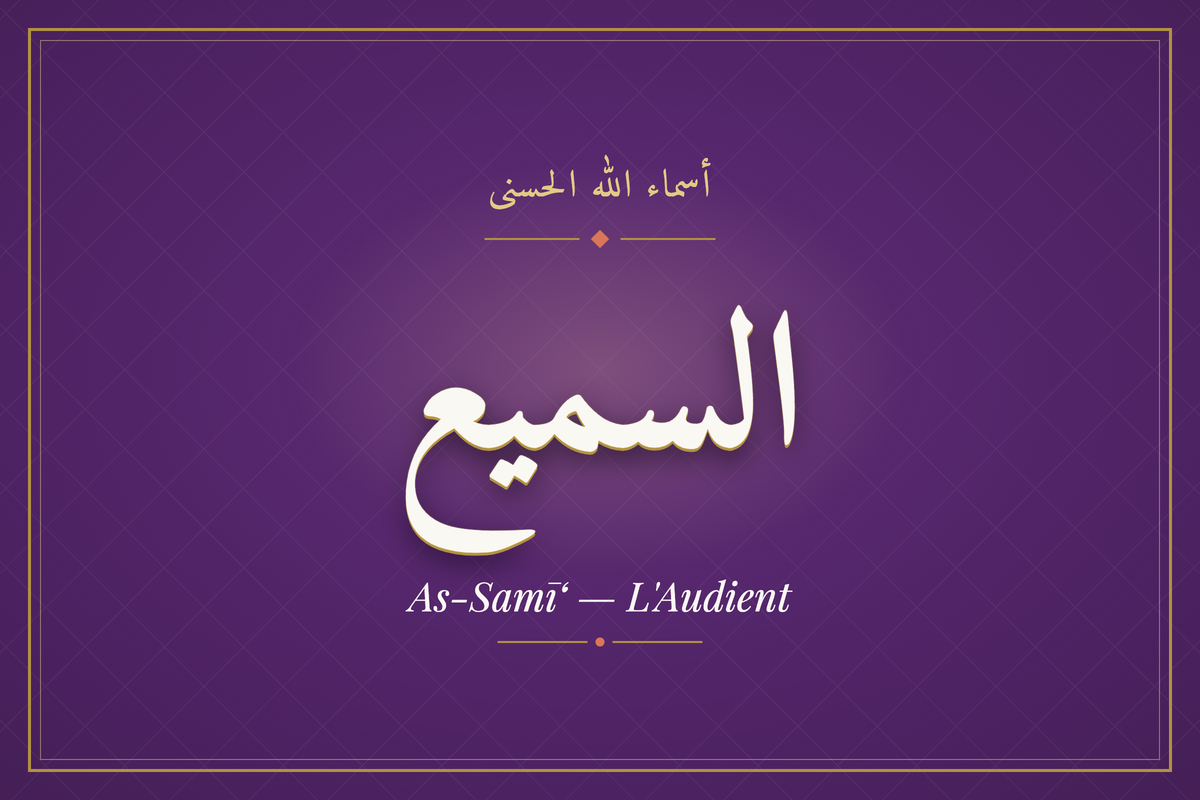
As-Samī' (السَّمِيع), "The All-Hearing," "He who hears all things," is one of the most beautiful Names of Allah. It designates He whose hearing encompasses all sounds at once: the complaint whispered in the night, the silent invocation of the heart, the voices of all creatures in all languages — without one sound covering another, without the multitude distracting Him. You are never without an interlocutor: He hears.
What does As-Samī' mean?
The name As-Samī' comes from the Arabic root sīn-mīm-'ayn (س م ع), which designates hearing and listening. Applied to Allah, this Name designates:
- A total hearing: Allah hears every sound, manifest or secret, near or far — without ear or instrument, with a hearing that befits His majesty.
- A listening that responds: to "hear," for Allah, is also to grant — as in the prayer formula "sami'a Llāhu liman hamidah": "Allah hears (grants) the one who praises Him".
- A benevolent vigilance: He hears the injustice of the tyrant as well as the distress of the oppressed — nothing is said that is not known and recorded.
As-Samī' in the Quran
Allah revealed an entire chapter — Al-Mujādala, "The Discussion" — about a woman who came to complain to the Prophet ﷺ about the situation her husband had imposed on her:
قَدْ سَمِعَ اللَّهُ قَوْلَ الَّتِي تُجَادِلُكَ فِي زَوْجِهَا وَتَشْتَكِي إِلَى اللَّهِ وَاللَّهُ يَسْمَعُ تَحَاوُرَكُمَا ۚ إِنَّ اللَّهَ سَمِيعٌ بَصِيرٌ
"Allah has indeed heard the words of the woman who disputes with you concerning her husband and complains to Allah. And Allah hears your dialogue. Allah is All-Hearing, All-Seeing." (Chapter Al-Mujādala, 58:1)
'Ā'isha — may Allah be pleased with her — marveled at this: from the seventh heaven, Allah heard the complaint of a woman that those in the same room could barely understand. And the prophet Ibrāhīm, having grown old, gave thanks:
"Praise be to Allah who, despite my old age, has given me Ismā'īl and Ishāq. Indeed, my Lord hears perfectly the supplication." (Chapter Ibrāhīm, 14:39)

Living with As-Samī' in Daily Life
1. Invoke with certainty of being heard
The Prophet ﷺ said to his companions who were raising their voices in dhikr: "You are not invoking a deaf one nor an absent one: you are invoking the All-Hearing, the Near." (reported by Al-Bukhārī and Muslim). There is no need to shout, no need for intermediaries — the whispered du'ā arrives in its entirety.
2. Guard your tongue
He who knows that As-Samī' hears every word weighs his words: neither backbiting, nor falsehood, nor gratuitous harm. The Prophet ﷺ said: "Let he who believes in Allah and the Last Day say what is good or remain silent." (reported by Al-Bukhārī and Muslim).
3. Confide in Allah before His creation
The woman of Surah Al-Mujādala "complained to Allah" — and Allah answered. When no one listens, when loved ones grow weary, there remains the One who is never weary of hearing. Make the night prayer your confidant.
Invocation with the name As-Samī'
While laying the foundations of the Ka'ba, Ibrāhīm and Ismā'īl were invoking: رَبَّنَا تَقَبَّلْ مِنَّا ۖ إِنَّكَ أَنتَ السَّمِيعُ الْعَلِيمُ
"Our Lord, accept this from us. Indeed, You are the All-Hearing, the All-Knowing." (Surah Al-Baqara, 2:127) — the invocation par excellence to recite after every good deed, to ask for its acceptance from the One who has heard and seen it.

Frequently Asked Questions about As-Samī'
What is the difference between As-Samī' and Al-Basīr?
The Quran often associates these two Names: As-Samī' hears all sounds, Al-Basīr sees all things. Together, they teach that nothing we say or do escapes Allah — the foundation of the believer's vigilance (murāqaba).
Does Allah also hear what the heart says without speaking?
Yes. His hearing does not depend on sound: He knows the thought before it becomes speech and the inner supplication before it crosses the lips. This is why the silent du'ā of the sick or the shy is heard exactly as the spoken supplication.
How do you invoke Allah by this Name?
Allah says: "To Allah belong the most beautiful Names. Invoke Him by these Names" (7:180). After each deed, say: "Rabbanā taqabbal minnā, innaka anta s-Samī' ul-'Alīm" (2:127), and in distress: "Yā Samī', isma' shakwāya" — "O All-Hearing, hear my complaint."
📚 Continue reading the 99 Names
−5 % off the entire library with code BLOG5
Valid on the entire site, with no minimum purchase — our thanks to blog readers.
Discover our books on the Names of Allah