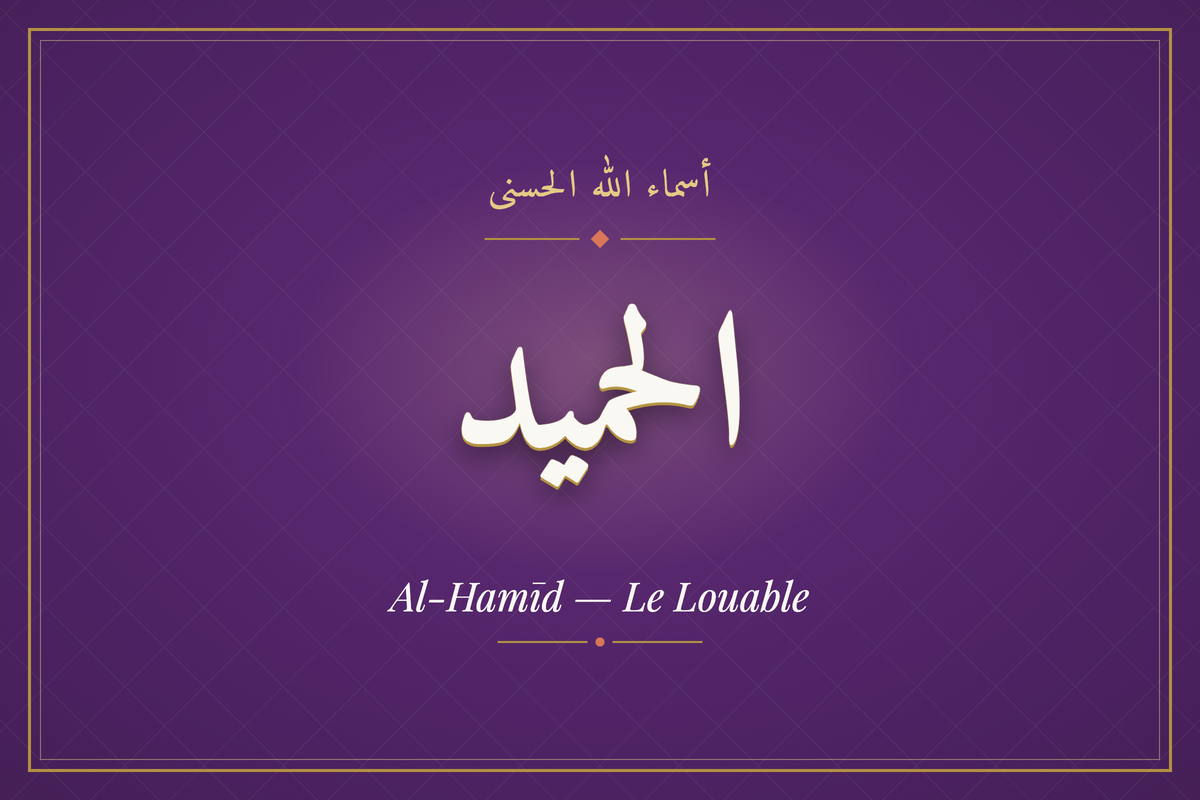
Al-Hamīd (الحَمِيد), "The Praiseworthy," "He who deserves all praise," is one of the most beautiful Names of Allah. It teaches us that praise is not a courtesy that one addresses to Allah: it is His right, by essence, whether men praise Him or not. The believer who discovers this Name understands why the first chapter of the Quran opens with al-hamdu lillāh — and why his own life benefits from opening in the same way.
What does Al-Hamīd mean?
The name Al-Hamīd comes from the Arabic root hā'-mīm-dāl (ح م د), which expresses praise mingled with love and veneration — the hamd, deeper than mere compliment. Applied to Allah, this Name designates:
- The Praiseworthy by essence: Allah deserves praise for what He is — His Names, His attributes, His perfection — even before any blessing received.
- The Praised in fact: all of creation celebrates His praise. "There is nothing that does not celebrate His praise" (Surah Al-Isrā', 17:44).
- He whose praise depends on no one: the ingratitude of men takes nothing from Him, just as their gratitude adds nothing to Him.
Al-Hamīd in the Quran
Allah says:
يَا أَيُّهَا النَّاسُ أَنتُمُ الْفُقَرَاءُ إِلَى اللَّهِ ۖ وَاللَّهُ هُوَ الْغَنِيُّ الْحَمِيدُ
« O mankind, it is you who are poor and in need of Allah, and Allah is the Rich, the Praiseworthy. » (Surah Fātir, 35:15)
And through the words of Mūsā:
« If you are ungrateful, you and all those who are on earth, know that Allah is Self-Sufficient and Worthy of Praise. » (Surah Ibrāhīm, 14:8)
The frequent association of Al-Ghanī (The Rich) and Al-Hamīd carries a precise teaching: His richness is not that of the powerful of this world, who take and oppress. It is a praiseworthy richness, which gives, forgives and bestows abundantly — a fullness from which all good flows.

Living with Al-Hamīd Daily
1. Open Your Day and Actions with Praise
The Fātiha, recited in every unit of prayer, begins with al-hamdu lillāhi rabbi-l-'ālamīn. The believer who internalizes Al-Hamīd makes this utterance a reflex: upon waking, after a blessing, at the end of an effort. Praise becomes the breath of the heart.
2. Praise Allah Also in Hardship
Praising Allah when all goes well is easy. The one who knows Al-Hamīd praises Him in all circumstances, for he knows that divine wisdom encompasses even what troubles him, and that the hardship itself conceals a good—purification, elevation, or protection.
3. Give Thanks for the Simplest Gestures
The Prophet ﷺ said: "Allah is pleased with His servant that he eats a morsel and praises Him for it, or drinks a sip and praises Him for it." (Muslim). The hamd transforms an ordinary meal into an act of worship.
Invocation with the Name Al-Hamīd
In every prayer, during the salutation upon the Prophet ﷺ (salāt ibrāhīmiyya), the Muslim seals his invocation with this Name: إِنَّكَ حَمِيدٌ مَجِيدٌ
"…You are indeed Worthy of all praise and full of glory." (Al-Bukhārī and Muslim). And in accordance with verse 7:180, you can invoke: "Yā Hamīd, make me among those who praise You in all circumstances."

Frequently Asked Questions about Al-Hamīd
What is the difference between hamd and shukr?
The shukr (gratitude) responds to a blessing received; hamd is broader: it praises Allah for His perfection itself, independent of any blessing. We thank Him for what He gives, we praise Him for what He is.
Why is Al-Hamīd often associated with Al-Ghanī?
Because absolute wealth without moral perfection would be dreadful. Allah is both the One who needs nothing and the One whose every act is worthy of praise: His power is inseparable from His goodness.
How do you invoke Allah by this Name?
Allah says: "To Allah belong the most beautiful Names. Invoke Him by these Names" (7:180). Multiply al-hamdu lillāh throughout the day, and say for example: "Yā Hamīd, grant me a grateful heart and a tongue that praises You."
📚 Continue reading the 99 Names
−5 % off the entire library with code BLOG5
Valid on the entire site, with no minimum purchase — our thanks to blog readers.
Discover our books on the Names of Allah